augustus 25, 2025
|8 minuten

In B2B marketing, performance is under constant scrutiny, yet a significant portion of resources may be vanishing into a black box. Research from Forrester[1] reveals a stark reality: CMOs report that, on average, 25% of their technology budget fails to deliver the expected ROI. This isn’t just a budget line item; it’s a massive drain on potential growth. Compounding this, Gartner[2] reports that B2B buyers now complete approximately 80% of their journey independently before ever contacting a sales representative. 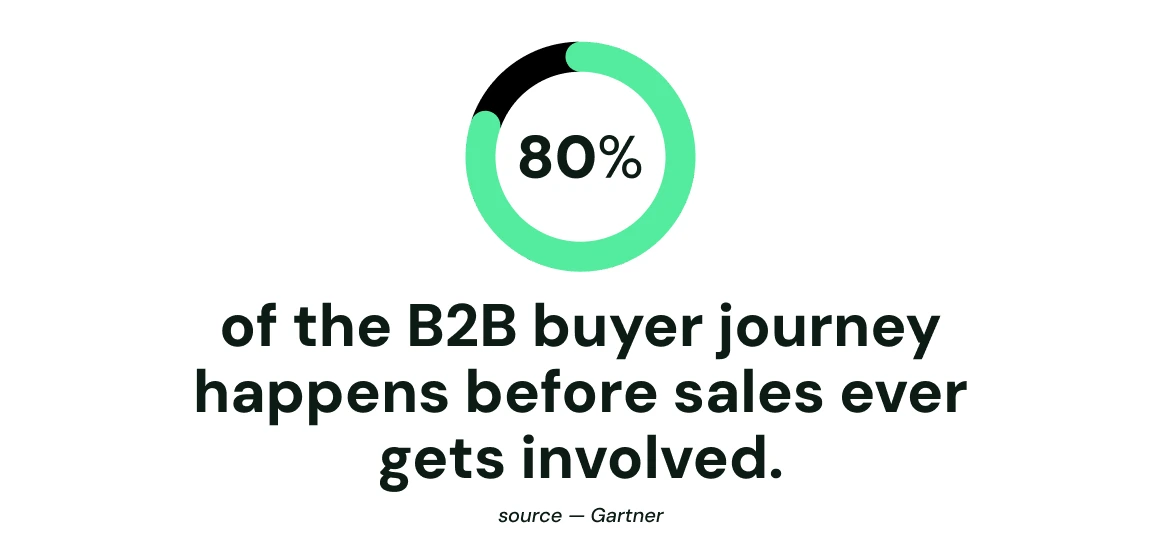 This means the most critical part of the conversion funnel—where prospects are won or lost—is happening digitally and, often, invisibly. Your current analytics can show you what happened, but they can’t explain the critical why behind the numbers. This is the blind spot where revenue leaks out. It’s time for a new approach. Artificial Intelligence (AI) is introducing a new paradigm for analytics. It moves beyond descriptive data (what happened) to deliver diagnostic and prescriptive insights (why it happened and what to do about it). AI analytics is not just another dashboard; it’s a diagnostic engine for your entire revenue funnel. It is designed to pinpoint and address leaks with data-driven precision. This article explores how to apply AI as a strategic lever to re-engineer your conversion funnel from the ground up. We will not discuss basic web analytics. Instead, we will explore five critical transformations that AI brings to Conversion Rate Optimization (CRO) and User Experience (UX):
Let’s move from observing the funnel to engineering its success.
Traditional analytics platforms are excellent at describing what happened. They can tell you your bounce rate, your time on page, and the conversion rate of a specific landing page. This is descriptive data—a snapshot of past events. Where it falls short is in explaining the “why” behind those numbers, leaving your team to manually interpret the data and form educated guesses. AI analytics introduces a crucial new layer: the ability to diagnose problems automatically. It acts as a tireless data scientist, sifting through millions of data points to find patterns and correlations that are invisible to the human eye. According to research by McKinsey[3], organizations that embed this kind of data-driven, AI-powered decision-making into their core processes see outsized returns and a significant competitive advantage.
From “What” to “Why” An AI-powered analytics engine can analyze thousands of user sessions and hypothesize why. For example, it might generate a specific insight like: “Users from Germany on Firefox browsers are 80% more likely to abandon the form when they reach the ‘Phone Number’ field, suggesting a potential data privacy concern or a UX issue specific to that browser.” 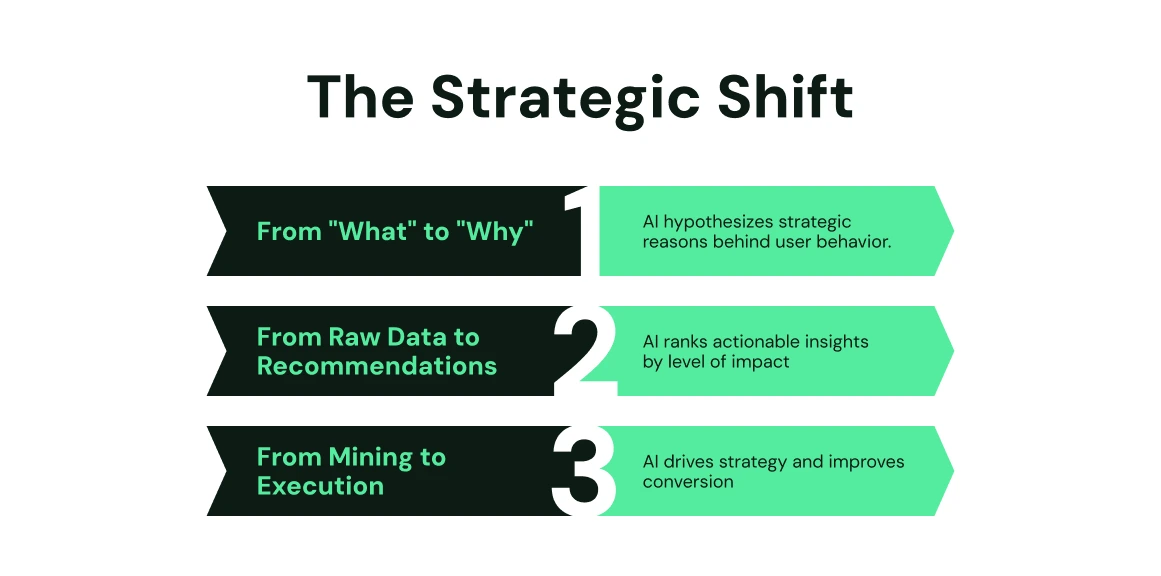 From Data Overload to Prescriptive Insights Instead of presenting raw data, AI surfaces prioritized, actionable recommendations. It doesn’t just give you a mountain of information; it hands you a short, strategic list of the biggest opportunities to improve conversion, ranked by potential impact. This fundamental shift frees up your team’s valuable time. They can move from data mining to strategy and execution, acting on high-confidence insights rather than debating hypotheses.
One of the greatest challenges in B2B marketing is the fragmented customer journey. A single prospect might interact with your brand across multiple devices and channels over several months. They may see a LinkedIn ad on their phone, read a blog post on their laptop, and attend a webinar on their tablet. Traditional analytics struggles to connect these disparate touchpoints, leaving you with an incomplete and misleading view of the conversion path. AI excels at stitching these fragments together. By integrating data from your Customer Relationship Management (CRM), marketing automation, and web analytics platforms, AI can construct a unified, end-to-end view of the account journey.
True Multi-Channel Attribution: You can finally see how different channels work together to influence conversion. AI can reveal that while email marketing may get credit for the final click, the initial awareness generated by a targeted ad campaign was a critical prerequisite for success. Identifying High-Value Pathways: AI can analyze thousands of conversion paths to identify the most efficient and effective journeys. For example, it might find that prospects who watch a specific webinar and then read a particular case study are 5x more likely to convert. This insight allows you to proactively guide other prospects down this proven high-value path. Eliminating Siloed Thinking: A unified view breaks down data silos between different regional teams or marketing functions. It provides a single source of truth for how customers are interacting with your brand globally, enabling more cohesive and intelligent strategic planning.
Where exactly do users get confused, frustrated, or lost on your website? Finding these specific points of friction is the core work of CRO. Manually, this involves watching session recordings and analyzing heatmaps—a time-consuming process that is impossible to do at scale. AI automates this process of friction detection. It can analyze every single user session to identify patterns of behavior that indicate frustration or confusion.
“Rage Clicks”: When a user repeatedly clicks on an element that isn’t clickable, indicating a design flaw or user confusion. Hesitation Time: When users pause for an unusually long time before filling out a specific form field, suggesting the request is unclear or asks for sensitive information too early. Erratic Mouse Movement: Un usually chaotic cursor movement can signal that a user is lost or cannot find the information they are looking for on a crowded page. JavaScript Errors: AI can correlate user drop-offs with specific technical errors that might only be affecting a subset of users (e.g., those on a particular browser or device). 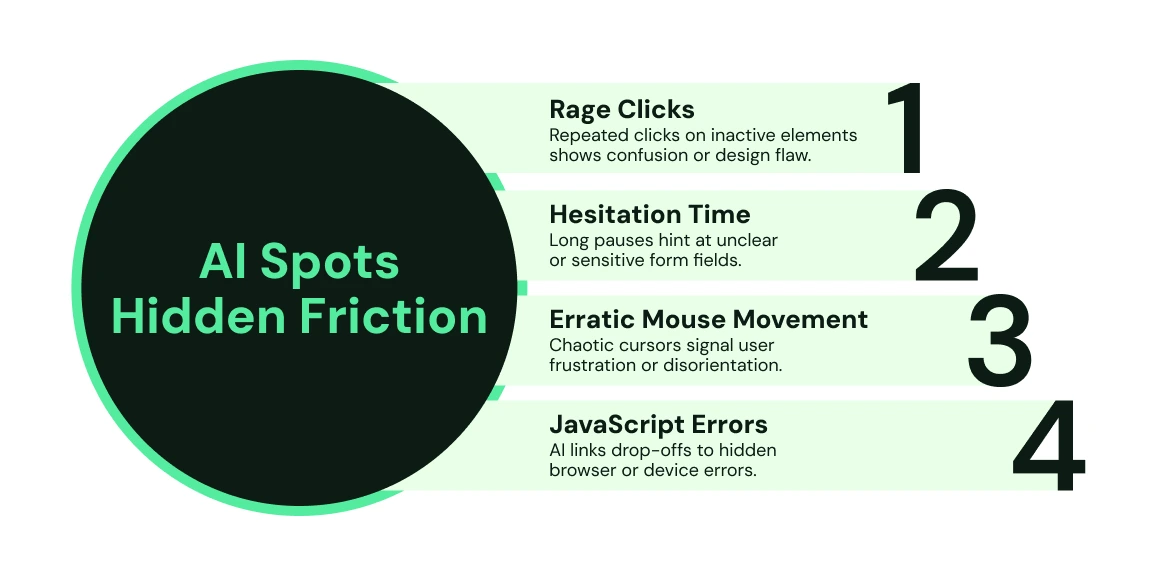 Crucially, AI doesn’t just flag the behavior; it provides context. The system can state that “75% of users who exhibit ‘rage clicks’ on the pricing table are on mobile devices,” immediately pointing your UX team toward a mobile-responsive design issue. This is automated root cause analysis, and it dramatically accelerates the optimization cycle.
Optimizing a marketing funnel for more leads is only half the battle. A truly effective revenue engine must also ensure that the sales team is focused on the leads most likely to convert into customers. A high volume of low-quality leads can be just as damaging as a low volume of high-quality leads, as it burns valuable sales cycles and drives up customer acquisition costs. This is where AI provides a critical bridge between marketing optimization and sales efficiency through predictive lead scoring. Traditional lead scoring models are based on static, rule-based systems (e.g., +10 points for a VP title, +5 for downloading a whitepaper). AI-powered scoring is dynamic and learns over time. It analyzes the attributes and behaviors of all your past customers to build a model of what a high-value lead truly looks like. It can identify subtle patterns—like the specific combination of pages a user visits—that are highly predictive of purchase intent. This allows you to prioritize leads with scientific precision. A lead with a 90% predictive conversion score can be fast-tracked directly to your most senior account executives, while a lead with a 30% score can be placed into a long-term automated nurture campaign. This optimizes the entire conversion path, not just the marketing portion. This transforms the sales-marketing relationship from one of tension into a strategic alignment focused on the shared goal of predictable revenue growth.
A/B testing is a foundational element of CRO. However, it is a slow, methodical process that can only test one variable at a time. For complex websites with dozens of potential elements to optimize, this approach can take months or even years to yield significant results. AI is transforming this landscape by enabling more intelligent and rapid experimentation. AI-Powered Multivariate Testing: AI can test dozens of combinations of elements (headlines, images, button colors, form fields) simultaneously. It can quickly process the results to identify not just the single best element, but theoptimal combination of elements for different user segments. Continuous Optimization: Instead of running a test, picking a winner, and stopping, AI can enable a state of continuous optimization. The system constantly experiments with small changes, learns from the results, and automatically allocates more traffic to better-performing variations. Generative AI for Hypothesis Creation: Emerging AI capabilities can even help generate new ideas for what to test. By analyzing your existing page and the identified points of friction, Generative AI can suggest alternative headlines, rephrased value propositions, or different layouts, providing your team with a constant stream of data-driven ideas to fuel the experimentation cycle. This moves an organization from a culture of periodic testing to one of continuous, intelligent optimization, creating a powerful and sustained competitive advantage.
The B2B conversion funnel is no longer a “black box” that must be accepted. It is an engine that can be systematically analyzed, diagnosed, and re-engineered for maximum performance. Traditional analytics allowed us to observe this engine; AI analytics gives us the tools to be its chief engineer. By moving from descriptive data to diagnostic insights, mapping the full customer journey, automating friction detection, prioritizing leads with predictive scoring, and embracing intelligent experimentation, you can transform your funnel from a passive pathway into a highly efficient, predictable revenue machine. Leveraging AI analytics is not merely a CRO tactic; it is a strategic imperative for driving sustainable, data-driven growth. Achieving this shift requires more than technology; it demands a new approach to growth. Now is the time to navigate this transformation and build the high-performance marketing engines of the future.


Ontvang nieuwe rapporten en inzichten van KKBC per e-mail.
 NL
NL 

 NL
NL